It is the question almost every novelist asks before trying an AI writing tool, and it is a fair one. You have spent years developing the way you put sentences together. The last thing you want is a book that reads like everyone else’s because a machine smoothed the edges off.
The honest answer is that AI can flatten your voice, but it does not have to. Whether it does depends almost entirely on how you use it. This article explains why AI prose drifts towards the generic, how to spot it in your own draft, and the habits that keep your voice intact.
Quick answer
Yes, if you let AI draft unattended and accept what it writes. Language models favour likely phrasing, so unedited output drifts towards familiar words, tidy rhythms and stock images. You keep your voice by writing the scenes you care about yourself, feeding the tool samples of your own prose, asking for options rather than replacements, and revising every AI sentence until it sounds like you.
Why AI prose drifts towards generic
Large language models generate text by predicting what is likely to come next, based on patterns in enormous amounts of writing. That is exactly why they are fluent, and exactly why they lean towards the middle. Left alone, a model reaches for the phrase most writers would use, the image most readers have seen and the sentence shape that rarely goes wrong.
Your voice lives in the opposite place: the unexpected word, the rhythm only you would choose, the detail nobody else noticed. So the risk is not that AI writes badly. It is that it writes averagely, and averageness is contagious when you accept it paragraph after paragraph.
There is a second, subtler effect. When you read a lot of AI-generated text while drafting, its habits start to feel normal, and they creep into the sentences you write yourself.
Signs your draft is losing its voice
Read a chapter aloud and watch for these patterns. One or two are harmless; a cluster means the AI is doing more of the writing than you think.
| Symptom | What it looks like | Fix |
|---|---|---|
| Named emotions | “She felt a wave of sadness wash over her.” | Show it through action or a specific physical detail. |
| Tidy triplets | “The room was quiet, cold and still.” | Keep the one detail that matters and cut the rest. |
| Stock images | Hearts pounding, breaths she didn’t know she was holding | Ask what this character would notice that nobody else would. |
| Explaining the subtext | Dialogue followed by a sentence explaining what it meant | Delete the explanation and trust the reader. |
| Uniform rhythm | Paragraph after paragraph of medium-length sentences | Vary length deliberately; let some sentences run, cut others short. |
| Sudden polish | A passage that sounds smoother than the rest of the chapter | Roughen it back to your register, or rewrite it from scratch. |
Seven habits that protect your voice
- Write the scenes you care about yourself. Use AI for scaffolding (outlines, transitions, a first pass at a scene you are dreading), not for the moments that made you want to write the book.
- Give the tool your prose, not just instructions. A page of your own writing tells a model more about your voice than any list of adjectives.
- Ask for options, not replacements. Request three versions of a line, then write a fourth that takes the best of them.
- Keep your craft choices explicit. Point of view, tense and tone should be set once and respected everywhere, so nothing slides into a neutral default.
- Revise every AI sentence. If a sentence survives into your draft, it should be because you would have been happy to write it.
- Read aloud. Your ear catches borrowed rhythm faster than your eye catches borrowed words.
- Draft some days with no AI at all. It keeps your own muscles working and gives you a baseline to compare against.
Use AI to get unstuck, never to get finished. The finishing is where your voice lives.
How tools can help, not homogenise
A well-designed writing tool should make these habits easier rather than fight them. In Bookh, three features exist specifically for this.
Voice & Style
Bookh analyses your manuscript and sets a voice profile, including maturity and tone, which it applies to drafts and suggestions. Instead of starting from the model’s average, it starts from your pages.
Originality check
When a passage feels too smooth, the Originality check helps you rework it so it reads like you rather than like AI. It is there to help you revise, and the final call is always yours.
Finish Chapter and Writing Lab
When you do want a draft, Finish Chapter continues a scene in your voice, tense and point of view, and Writing Lab drafts the next few paragraphs. Both produce text you edit, keep or throw away, which is exactly the relationship you want with AI prose.

Write with AI that starts from your voice. Bookh learns from your manuscript so its suggestions sound like you, and every one of them is yours to change. Free to start, no credit card.
Whatever tool you use, the principle is the same: choose software that treats your writing as the source of truth and AI output as raw material. Our comparison of AI writing tools for novelists looks at how different tools handle voice.
Is it still your book?
If you came up with the story, made the structural decisions, wrote the scenes that carry it and revised every sentence that remains, most writers would say yes. The more the AI decides and the less you revise, the less that is true. A useful test: could you defend every line in the book as a choice you made?
Publishing platforms and contests are also developing their own rules about AI-generated content, and some ask authors to disclose it. Check the current guidelines of wherever you plan to publish or submit.
FAQ
Will AI make my novel sound generic?
It can if you accept its output unedited, because models favour the most likely phrasing. If you write key scenes yourself, give the tool samples of your prose and revise everything it suggests, your voice stays yours.
How do I make AI writing sound like me?
Give it real examples of your writing, set point of view, tense and tone explicitly, ask for several options and then rewrite the best one in your own words. Tools with voice profiles, such as Bookh’s Voice & Style, do part of this automatically.
Can readers tell if a novel was written with AI?
Readers often notice generic patterns such as named emotions, stock images and uniform rhythm, even if they cannot say why. Heavily revised AI-assisted prose is much harder to spot because it carries the author’s choices.
Should I avoid AI entirely to protect my voice?
Not necessarily. Many writers use AI for outlining, brainstorming and getting past stuck transitions while writing the important scenes themselves. The risk comes from letting it draft unattended, not from using it at all.
Is using AI for writing cheating?
That depends on how much of the work it does and the rules of where you publish. Using AI as a co-pilot for planning and revision is widely accepted; passing off unedited AI text as entirely your own is not.
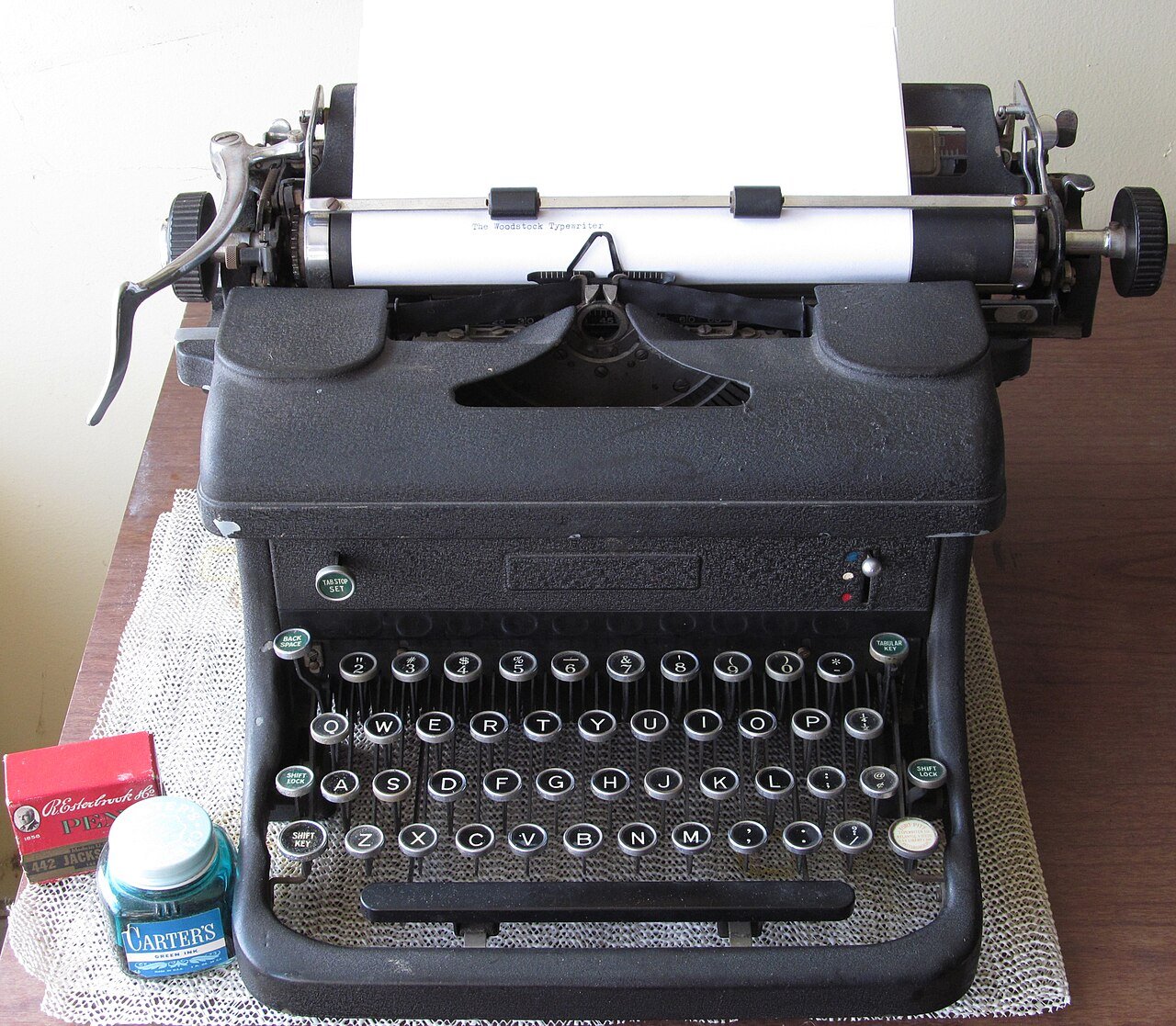
Cover image: “Woodstock typewriter, 1940s, daylight” by Cbaile19, via Wikimedia Commons, CC0.